
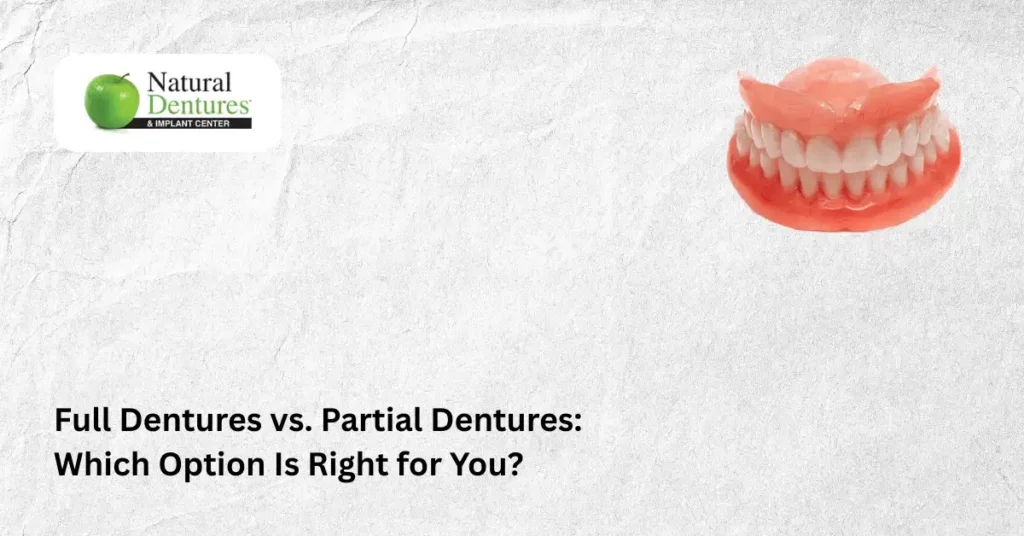
If you’re missing some or all of your natural teeth, you’ve likely heard the same two terms over and over: full dentures and partial dentures. Both restore your ability to chew, speak, and smile with confidence — but they’re built for very different mouths and very different stories. Choosing the right one shapes everything from how you eat Sunday dinner to how much you’ll spend over the next decade.
At Natural Dentures & Implant Center of Oregon, we’ve been handcrafting custom dentures in our labs for more than 40 years and have restored over 30,000 smiles across Eugene, Salem, Corvallis, and Roseburg. Below is the same straightforward comparison we walk patients through during their free first visit — no jargon, no sales pitch, just the information you need to make a confident decision.
Full Dentures vs. Partial Dentures: The Short Answer
| Quick Answer
Full dentures replace an entire arch of missing teeth (top, bottom, or both) and rest on the gums. Partial dentures replace only the missing teeth in an arch and clip onto your remaining natural teeth for support. Choose full dentures when no healthy teeth remain in an arch; choose partial dentures when you still have stable natural teeth worth saving. |
That’s the 30-second version. The rest of this guide breaks down exactly how each option works, what they cost in Oregon in 2026, who qualifies, and how to know which one fits your situation.
What Are Full Dentures?
Full dentures — also called complete dentures — are a removable dental prosthesis that replaces every tooth in your upper jaw, your lower jaw, or both. Each denture consists of natural-looking acrylic teeth set into a gum-colored acrylic base that rests directly on your gums and underlying jawbone.
Upper full dentures use natural suction against the roof of your mouth (the palate) to stay in place. Lower full dentures rely on the muscles of the cheeks, lips, and tongue, which is why a well-crafted lower denture takes more skill to fit comfortably than an upper one.
Who is a candidate for full dentures?
Full dentures are typically recommended when an entire arch of teeth is either missing or beyond saving due to advanced decay, gum disease, trauma, or long-term wear. A licensed denturist or dentist will recommend a full denture when the remaining teeth in an arch can no longer support a partial denture or are causing more harm than good.
There are two main types of full dentures you’ll hear about:
- Conventional full dentures: Made and fitted after any remaining teeth have been extracted and the gums have healed (usually 8–12 weeks).
- Immediate dentures: Crafted in advance and placed the same day your remaining teeth are removed, so you never go a day without teeth. At Natural Dentures, this is part of our Dentures in a Day service.
What Are Partial Dentures?
Partial dentures replace one or more missing teeth in an arch where healthy natural teeth still remain. A partial fills in the gaps and uses your remaining teeth as anchors, typically with small metal clasps, precision attachments, or flexible thermoplastic that hugs the gum line.
Because partials clip into place, they offer significantly more stability than a full denture sitting on bare gums — and they help prevent your remaining teeth from drifting into the empty spaces, which is one of the most underrated long-term benefits.
The three main types of partial dentures
Not all partial dentures are built the same. The right one depends on which teeth are missing, how visible the clasps will be, and your budget.
- Cast metal partial dentures: A thin cobalt-chromium framework with acrylic teeth and gum-colored saddles. The most durable and longest-lasting option.
- Flexible (thermoplastic) partial dentures: Made from a flexible nylon-based material with no visible metal clasps. Comfortable and discreet, ideal when aesthetics matter most.
- Acrylic (transitional) partial dentures: An all-acrylic partial is often used as a temporary or budget-friendly option, sometimes called a ‘flipper’ when it replaces a single front tooth.
Who is a candidate for partial dentures?
Partial dentures are the right choice when you have at least a few healthy, stable teeth in an arch — typically the canines or molars — that can serve as reliable anchors. Your gums and supporting bone also need to be in reasonable shape to handle the gentle pressure of the clasps.
Full Dentures vs. Partial Dentures: Side-by-Side Comparison
Here’s how the two options compare across the factors that matter most to patients:
| Factor | Full Dentures | Partial Dentures |
| Teeth replaced | All teeth in the upper, lower, or both arches | One or several missing teeth in an arch |
| Required natural teeth | None — used when no teeth remain | Some healthy teeth are needed as anchors |
| How it stays in place | Suction (upper) or muscle control (lower); adhesive optional | Clasps or precision attachments on natural teeth |
| Typical cost (Oregon, 2026) | $900–$3,500 per arch (economy to premium) | $900–$2,800 per arch (acrylic to cast metal) |
| Lifespan | 5–10 years with proper care | 3–10 years; depends on remaining teeth |
| Adjustment period | Several weeks for speech and chewing | Usually, a few days to a couple of weeks |
| Effect on bone health | Some bone loss over time; implant support reduces this | Helps preserve remaining teeth and bone |
| Daily care | Remove and clean nightly; soak in denture solution | Remove and clean nightly; brush remaining teeth normally |
| Best for | Patients with no healthy teeth left in an arch | Patients with several healthy, stable teeth remaining |
How Do You Know If You Need Full or Partial Dentures?
The simplest test is whether you still have enough healthy teeth in an arch to anchor a partial denture. If you do, a partial is almost always the better long-term choice because it preserves your natural teeth and slows jawbone loss. If your remaining teeth are loose, painful, decayed beyond repair, or affected by advanced gum disease, a full denture (or implant-supported denture) becomes the smarter option.
During a free first visit at Natural Dentures, a licensed denturist will evaluate four things to make a clear recommendation:
- How many healthy teeth remain in each arch, and where they’re located
- The condition of your gums and supporting jawbone, often confirmed with X-rays
- Your bite, jaw alignment, and how your remaining teeth function together
- Your goals, lifestyle, budget, and whether you want a removable or implant-supported solution
Sometimes the answer is mixed — a full denture on the upper arch and a partial on the lower, for example. That’s completely normal, and a customized treatment plan accounts for it.
How Much Do Full Dentures and Partial Dentures Cost in Oregon in 2026?
| Cost at a Glance
In Oregon in 2026, full dentures typically range from $1,200 to $3,500 per arch and partial dentures from $900 to $2,800 per arch. Final pricing depends on the materials used (economy, mid-range, or premium), whether extractions are needed, and whether you choose any implant support. Natural Dentures offers a free first visit so you receive an exact, written estimate before committing. |
Full denture pricing is shaped mainly by the quality of teeth used (basic acrylic vs. higher-grade or porcelain teeth), the precision of the fit, and whether the denture is conventional or immediate. Partial denture pricing is driven mostly by the framework material — acrylic is the most affordable, flexible thermoplastic sits in the middle, and cast cobalt-chromium metal is the most durable and the longest-lasting investment.
Many Oregon patients also use dental insurance, OHP coverage where eligible, or financing through CareCredit and similar programs. We walk through every option during your consultation so cost never gets in the way of your smile.
What Are the Pros and Cons of Each Option?
Full Dentures: Pros
- Restore a complete smile when no natural teeth remain in an arch
- More affordable upfront than full-arch implants
- Available the same day as extractions through immediate denture programs
- Eliminate the pain of failing or infected teeth
- Modern materials look remarkably natural — far from the dentures your grandparents wore
Full Dentures: Cons
- Some bone loss in the jaw over time, which can change facial shape
- Lower full dentures can shift; many patients eventually choose snap-on implant support
- A few weeks of adjustment for speech, chewing, and confidence
- Need to be removed nightly for cleaning and to let gums rest
Partial Dentures: Pros
- Preserve your remaining healthy teeth and the jawbone around them
- More stable and secure than a full denture because they clip onto natural teeth
- Faster to adjust to — most patients adapt within days
- Generally more affordable than implant bridges
- Prevent neighboring teeth from drifting into the empty spaces
Partial Dentures: Cons
- Metal clasps can sometimes be visible (flexible options solve this)
- The teeth holding the clasps need careful daily cleaning to avoid decay
- If a supporting tooth fails, the partial may need to be remade or converted to a full denture
- Not an option if too few healthy teeth remain
How Long Do Full Dentures and Partial Dentures Last?
With proper daily care, both full dentures and partial dentures typically last between 5 and 10 years before they need replacement. Their fit, however, will change long before they wear out — gums and jawbone naturally remodel over time, especially in the first year after extractions, which is why periodic relines and adjustments are part of normal denture life.
This is exactly why Natural Dentures includes free adjustments for the life of your teeth. A small reline at year three is far less expensive — and far more comfortable — than waiting until something breaks.
Can You Switch from Partial Dentures to Full Dentures Later?
Yes. Many patients start with a partial denture and transition to a full denture years later when their remaining natural teeth eventually fail. This is a common, well-understood path, and a partial can sometimes be converted into an immediate full denture so you never go without teeth during the transition.
The reverse — moving from a full denture back to a partial — isn’t possible because the natural teeth needed for anchoring are no longer there. That’s one more reason the question ‘should we save these teeth?’ deserves a careful, expert second opinion before any extractions.
What About Implant-Supported Dentures?
Both full and partial dentures can be enhanced with dental implants, and this option has become significantly more accessible in 2026. An implant-supported denture (sometimes called an overdenture or snap-on implant denture) clips onto two or more titanium implants placed in the jawbone, giving you the stability of natural teeth with the convenience and price point closer to traditional dentures.
Implant support solves the most common complaint about lower full dentures (slipping when you eat or speak) and dramatically slows the bone loss that comes with conventional full dentures. For full-arch reconstruction, our team also offers All-on-4 fixed implant dentures, which never come out and look and feel closest to natural teeth.
If you’re weighing full vs. partial dentures, ask your denturist whether two or four strategic implants might be a smart middle path — the cost is often a pleasant surprise.
How to Choose Between Full and Partial Dentures: A 5-Step Framework
Use this decision framework as a starting point. The final recommendation should always come from a licensed denturist after an exam, but these five questions get you 90% of the way there.
- Count your healthy teeth in each arch. If you have several stable, decay-free teeth, lean partial. If an arch is empty or your remaining teeth are failing, lean full.
- Ask a denturist about your jawbone and gum health. Both options need a stable foundation; bone grafting or healing time may be needed first.
- Define your budget realistically — including the next 10 years, not just upfront cost. Partials sometimes need replacement when an anchor tooth fails; full dentures are predictable but may benefit from added implant support later.
- Think about your lifestyle. Do you eat tough or chewy foods regularly? Do you speak publicly? These shape whether you need maximum stability (favoring implant support) or simply a comfortable, removable solution.
- Get a free second opinion before any irreversible step like extractions. At Natural Dentures, second opinions are always free — we’d rather you make the right choice than the fast one.
Frequently Asked Questions: Full vs. Partial Dentures
Are partial dentures better than full dentures?
Partial dentures are not universally ‘better’ — they’re better when you still have healthy natural teeth worth keeping. They preserve your remaining teeth, slow jawbone loss, and offer more stability than a full denture. But if your remaining teeth are loose, painful, or beyond repair, a full denture (or implant-supported denture) is the better long-term choice.
Can you sleep with full or partial dentures?
Dentists and denturists almost always recommend removing dentures at night. Sleeping without your dentures lets your gums rest, reduces the risk of fungal infections (denture stomatitis), and helps your dentures last longer. The only common exception is during the first 24 hours after immediate denture placement.
Do partial dentures damage your remaining teeth?
A well-fitted partial denture should not damage your remaining teeth. The risk comes from poor cleaning around the clasps, which can lead to decay or gum disease in the anchor teeth. Brushing and flossing carefully twice a day, removing your partial nightly, and keeping regular dental checkups protects those teeth for the long term.
How long does it take to get used to dentures?
Most patients feel comfortable with partial dentures within a few days to two weeks. Full dentures typically take longer — often 4 to 8 weeks — because your tongue, cheeks, and lips have to learn an entirely new shape in your mouth. Practicing speech and starting with soft foods speeds the process considerably.
Can I eat normally with full or partial dentures?
Yes, with practice. Most patients can return to nearly their full diet, though particularly hard or sticky foods (whole apples, caramels, tough steak) often need to be cut smaller or avoided. Implant-supported dentures restore the most chewing strength and let you eat with the most confidence.
Will dentures change the way I look?
Properly designed dentures should restore your face to a natural, youthful shape — supporting the lips and cheeks the way your natural teeth once did. Cheap, mass-produced dentures can look obvious; custom-crafted dentures designed to your facial proportions, lip line, and skin tone look remarkably like your own teeth.
Does insurance cover full or partial dentures in Oregon?
Most dental insurance plans cover a portion of either full or partial dentures, typically 50% up to an annual maximum. Oregon Health Plan (OHP) covers basic dentures for eligible adults. Natural Dentures verifies your insurance benefits before treatment so you know exactly what you’ll pay out of pocket.
How Natural Dentures Helps You Choose with Confidence
Choosing between full and partial dentures is one of the most personal decisions in dentistry — and it deserves more than a five-minute conversation. At Natural Dentures & Implant Center, our denturists, dentists, and on-site Oregon labs work together to give you a complete picture before you commit to anything.
Every patient receives:
- A free first visit with a complete exam and personalized recommendation
- Free second opinions if you’re unsure about a treatment plan from another provider
- Custom-crafted dentures made by hand in our Oregon laboratories — never outsourced
- Options for every budget, from premium dentures to entry-level economy options
- Free adjustments for the life of your teeth, so they keep fitting comfortably year after year
- Same-day service available through Dentures in a Day at all Oregon locations
With more than 40 years of experience, 30,000+ restored smiles, and four locations across Eugene, Salem, Corvallis, and Roseburg, we’re the denture experts your dentist trusts — and we’re right here in the Willamette Valley.
| Give Us 30 Minutes — and We’ll Have You Smiling Again
Schedule your free first visit at Natural Dentures & Implant Center to find out whether full dentures, partial dentures, or an implant-supported option is right for you. No pressure, no obligation, no charge. Call 866-551-3509 or visit naturaldentures.com to book your consultation in Eugene, Salem, Corvallis, or Roseburg. |
About Natural Dentures & Implant Center: Family-owned since 1981, Natural Dentures & Implant Center is Oregon’s trusted denture and implant clinic with locations in Eugene, Salem, Corvallis, and Roseburg. Founded on a legacy that helped legalize the denturism profession in Oregon, our team has crafted custom dentures and restored smiles for more than 40 years. naturaldentures.com | 866-551-3509