
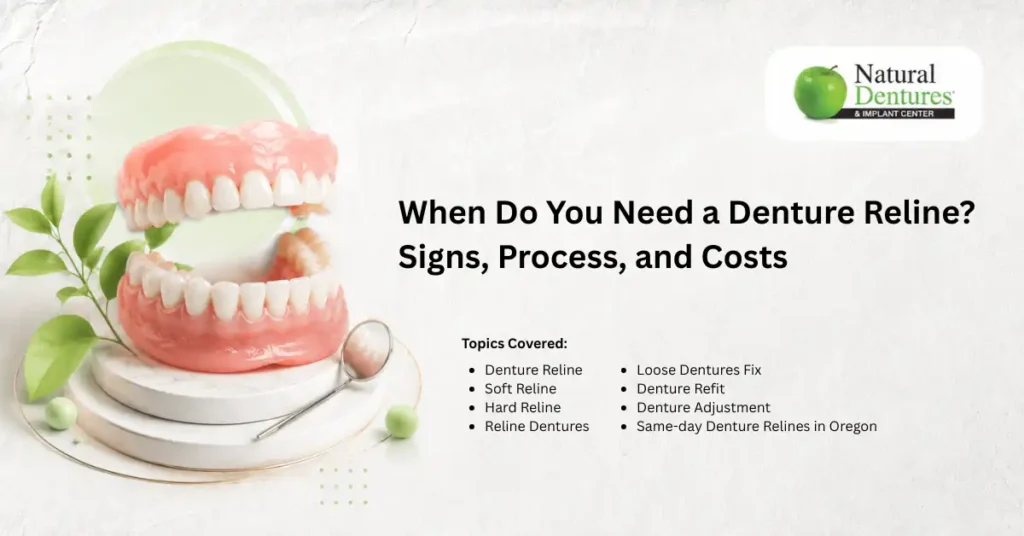
If your once-snug dentures have started slipping, clicking, or rubbing sore spots into your gums, the fix is often simpler than you might think — a denture reline. A reline resurfaces the tissue-facing side of your denture, so it matches the current shape of your gums and jaw, restoring a comfortable, secure fit without replacing the whole denture.
Because your jawbone naturally changes shape after teeth are removed, even a perfectly made denture will loosen over time. Knowing the signs, your options, and the typical costs helps you act early — before a loose fit turns into sore gum or trouble eating.
At Natural Dentures & Implant Center, we’ve handcrafted dentures in our own on-site Oregon laboratories for more than 40 years. That means many relines can be completed the same day, right here in Oregon — not shipped off to an outside lab. Here’s everything you need to know.
What Is a Denture Reline?
Quick answer: A denture reline is a procedure that adds a fresh layer of material to the underside of an existing denture so it fits the current contours of your gums and jaw. It reshapes only the fitting surface — your denture teeth and outer shape stay the same — making a loose denture feel secure again.
Over time, the ridge of bone and gum tissue that supports your denture gradually shrinks, a natural process called bone resorption. The denture itself doesn’t change, so a once-tight fit slowly loosens. A reline restores the contact between the denture and your gums by resurfacing the part that rests against your tissue.
A reline is different from a denture repair, which fixes a crack or a broken tooth, and from a full replacement, which creates an entirely new denture. When your denture is otherwise in good shape, a reline is one of the most affordable ways to extend its life and comfort.
When Do You Need a Denture Reline?
Quick answer: You likely need a denture reline if your dentures feel loose, slip when you talk or eat, cause new sore spots or gum irritation, trap food underneath, or click and rock in place. Most people need a reline every one to two years as their gums and jaw change shape.
Watch for these common signs that it’s time for a reline:
- Loose or slipping dentures that shift when you speak, laugh, or chew
- New sore spots, redness, or gum irritation where the denture presses
- Food getting trapped underneath the denture
- A denture that rocks, clicks, or needs more and more adhesive to stay put
- Difficulty chewing comfortably
- It has been two or more years since your last reline
- For immediate denture wearers, a fit that loosens as your gums heal after extractions
If you notice any of these, it’s worth a quick visit. Catching a loose fit early helps prevent sore gums and keeps you eating and smiling comfortably.
What’s the Difference Between a Soft Reline and a Hard Reline?
Quick answer: A soft reline uses a pliable, cushioning material that’s gentler on tender gums and typically lasts one year. A hard reline uses durable acrylic that matches your denture base, fits more precisely, and usually lasts two to four years. Your denturist recommends the right option based on your gum health and how your fit has changed.
| Feature | Soft Reline | Hard Reline |
| Material | Pliable, cushioning liner | Firm acrylic, like the denture base |
| Best for | Tender or sensitive gums, healing tissue, immediate dentures | Stable gums, a long-lasting fit, full dentures |
| Comfort | Very gentle on sore gums | Firm, precise, secure fit |
| Typical lifespan | 1 year | 2–4 years |
| Relative cost | Lower upfront, replaced more often | Slightly higher, lasts longer |
There’s also a temporary (or conditioning) reline — a very soft material used to soothe and heal irritated gums, often after extractions, before a longer-term soft or hard reline is placed. Your denturist will discuss which option best fits your needs, comfort, and budget. As we always say, it’s up to you to choose.
How Is a Denture Reline Done?
Quick answer: To reline a denture, your denturist removes a thin layer from the fitting surface, places a soft impression material inside the denture, and has you bite down so it captures the exact shape of your gums. That impression then guides the new lines, often finished the same day when there’s an on-site lab.
A reline is a comfortable, non-surgical process. Here’s what to expect, step by step:
- Exam and fit check — Your denturist examines your gums and denture to confirm a reline — rather than a repair or replacement — is the right step.
- Surface prep — A thin layer of the old fitting material is removed to make room for the new lining.
- Impression — A putty-like material is placed inside the denture, and you bite down so it captures the current shape of your gums and ridge.
- Lab finishing — The impression guides the new soft or hard lining. With an on-site lab, this happens in-house instead of being mailed out.
- Fit and adjust — The relined denture is checked, polished, and fine-tuned so it sits comfortably and securely.
Can You Get a Denture Reline the Same Day?
Quick answer: Yes. Many relines can be completed the same day when a clinic has its own on-site dental lab. At Natural Dentures & Implant Center, our on-site Oregon laboratories handle relines in-house, so you’re rarely left without your dentures for days — unlike clinics that mail relines to an outside lab.
Where you have your reline done makes a real difference. Many dental offices send hard relines to an outside laboratory, which can mean going several days without your dentures. Because we craft and finish dentures in our own Oregon labs, our denturists can often complete a reline while you wait.
Same-day, in-office relines typically take about 30 to 90 minutes, depending on the type — which fits our promise: give us 30 minutes and we’ll have you smiling again.
How Much Does a Denture Reline Cost?
Quick answer: A denture reline generally costs between $150 and $500 in the U.S., depending on whether it’s a soft or hard reline, your denture type, and your location. That’s far less than replacing a denture, which is why a reline is one of the most affordable ways to restore a comfortable fit.
A few factors influence the price of a reline:
- Reline type — soft relines often cost less upfront; hard relines run a bit higher but last longer
- Full vs. partial denture — larger dentures use more material
- Condition of the denture — cracks or heavy wear may need repair first
- Whether additional lab work is involved
Because every smile is different, the most accurate number comes from an in-person look. We’ll always give you a clear, honest overview — including an approximate cost — before any work begins. Your first visit, including the exam, is free, and we offer free second opinions if you simply want a plan for your smile.
One quick clarification: free lifetime adjustments (which we include) and a reline are not the same thing. An adjustment is a minor tweak to relieve a sore spot, while a reline resurfaces the entire fitting side of the denture once your gums have changed shape.
How Often Should Dentures Be Relined?
Quick answer: Most denture wearers need a reline every year for soft relines and every two to four years for hard relines. Your jawbone keeps changing shape after tooth loss, so regular relines keep your dentures fitting like new.
The pace depends on how quickly your gums and jawbone change, which is fastest in the first year after extractions and then slows. New denture wearers and immediate-denture patients often need an earlier reline as healing settles. Routine checkups let your denturist catch a loosening fit before it causes discomfort.
Denture Reline vs. Replacement: Which Do You Need?
Quick answer: Choose a reline when the denture itself is in good shape but no longer fits snugly. Choose a replacement when the teeth are worn flat, the base is cracked or warped, or you find yourself needing relines very often. A reline is the more affordable option whenever it’s appropriate.
A reline reshapes the fitting surface, so it’s ideal when your gums have changed but the denture is otherwise sound. Over many years, though, denture teeth wear down, the acrylic can weaken or stain, and the fit may no longer hold even after relining. At that point, a freshly handcrafted denture restores both function and a natural-looking smile. Your denturist will walk you through the trade-offs so you can decide what’s right for you.
Should You Use a DIY Denture Reline Kit?
Quick answer: It’s best to avoid over-the-counter DIY reline kits. They can create an uneven fit, trap bacteria, irritate your gums, damage the denture, and may void any warranty. A professional reline is precise, longer-lasting, and protects your oral health.
DIY kits seem convenient, but the material rarely matches the true shape of your gums, and a poor fit can lead to sore spots or even speed up bone loss. A professional reline costs more than a kit, but it lasts far longer and is far kinder to your gums.
Frequently Asked Questions
Does a denture reline hurt?
No. A reline is a comfortable, non-surgical procedure. Your denturist simply takes an impression inside your existing denture — there’s no drilling or anesthesia involved.
How long does a denture reline last?
A soft reline typically lasts one to two years, and a hard reline two to four years, depending on how your gums and jawbone change over time.
Will insurance cover a denture reline?
Coverage varies by plan — many policies cover relines partially or on a set schedule. We’re happy to help you check your benefits before your appointment.
Can all four Natural Dentures locations do relines?
Yes. Our Eugene, Salem, Corvallis, and Roseburg offices all offer denture relines, backed by our on-site Oregon labs for fast, same-day turnaround.